Research Highlights
Research Highlights
Optimal Polarization Modulation and Calibration Schemes
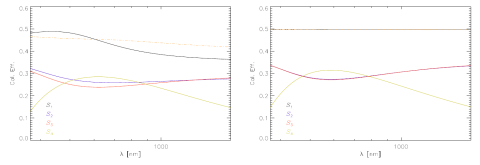
Authors R. Casini, D. Harrington, and A. de Wijn review the algebraic definition of the efficiency of a polarization modulation scheme, which is commonly adopted for solar and stellar spectro-polarimetry applications, and generalize it to allow distinct states of the modulation cycle to have arbitrary throughput and different photon-noise statistics for each state.
The Ionospheric Lunar Tidal Response to the 2020-2021 Sudden Stratospheric Warming Observed by COSMIC-2, ICON and Modeled by SD-WACCMX, TIE-GCM
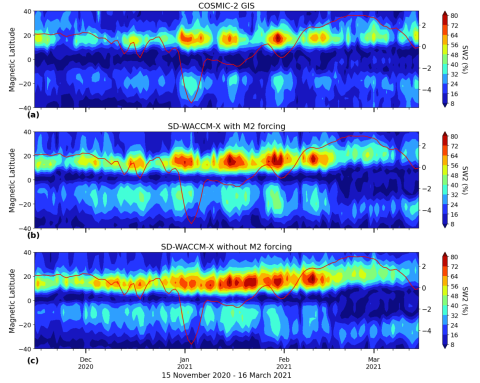
D. Aggarwal, S. Kumar, B. C. Martinez, N. M. Pedatella, X. Lu, and J. Oberheide examine how a major SSW in 2020-2021 affected global atmospheric waves called lunar tides using electron density data from the COSMIC-2 satellite (GIS), vertical plasma drifts from NASA’s ICON mission, and simulations from the SD-WACCM-X and TIE-GCM model.
Sudden ionospheric disturbances generated by solar flares—not so sudden?
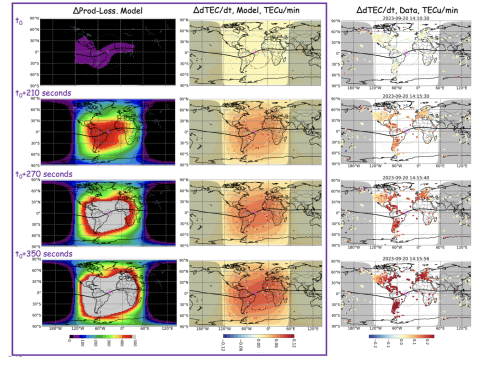
B. Maletckii, E. Astafyeva, N. M. Pedatella, and L. Qian use high-rate 1Hz data of ionospheric total electron content (TEC) and we analyze ionospheric effects of 13 solar flares that occurred between 2003 and 2023. For the first time, we demonstrate that the SID first appears at the subsolar point (i.e., the point where the Sun is directly overhead), and further expands to the twilight regions at a very high speed.

Joint Diagnostics of Circumsolar Sky Brightness Using Coronagraphic Measurements and Aersol Optical Inversions at Mauna Loa
Schad, Bryans, Fehlmann, Gibson, Harrington, Tarr, Tomczyk, and Yepez compare externally occulted coronagraphic measurements of near-Sun radiance with aerosol-constrained inferences derived from direct-Sun and sky photometry—focusing on the Mauna Loa Observatory, a well-characterized high-altitude site for atmospheric and solar observations.

Near-Ultraviolet Spectropolarimetry as a tracer of Magnetic Markers of Flux Rope Formation
Authors D. Afonso Delgado, R. Centeno, R. Casini, and M. Rempel investigate the suitability of the combined spectral windows of Mg II h and k and the Fe II lines around 261 nm as magnetic markers of filament formation.

Polarization Diagnostics Applied to Coronal Mass Ejections and the Background Solar Wind
Sarah E Gibson, Craig E. DeForest, Curt A. de Koning, Steven R. Cranmer, Yuhong Fan, Huw Morgan, Elena Provornikova, Anna Malanushenko, and David Webb use PUNCH polarization data to analyze individual lines of sight to three-dimensional models of coronal mass ejections (CMEs), allowing consideration of how accurately polarization properties of the transient and quiescent solar wind are diagnosed.

Advancing Heliophysics and Space Weather Modeling through Open Science
HAO first author, Michael Wiltberger, et. al. highlight a community-wide effort to understand how “open science” practices can better support research and forecasting in heliophysics and space weather.

Quantifying Day-To-Day Variability of the Ionosphere and Thermosphere Induced by Upward Propagating Migrating Diurnal and Semidiurnal Tides
Tianyang Hu, Liying Qian, Nicholas Pedatella, Wenbin Wang, and Quan Gan use a whole atmosphere model, the Whole Atmosphere Community Climate Model with thermosphere‐ionosphere eXtension (WACCM-X), to investigate the role of upward propagating migrating diurnal and semidiurnal tides on the day-to-day variability in the I-T system.

Refining the Magnetic Field Estimate for the Solar Polar Region
Bryan Yamashiro, Xudong Sun, Ivan Milic, Carlos Quintero Noda, Jiayi Liu, Adur Pastor Yabar, Rebecca Centeno, Milan Gosic, and Kai Yang analyze a raster map of the southern polar region taken by the Hinode Spectro-Polarimeter, utilizing the Stokes Inversion based on Response functions code. The inversions provide height-dependent vector magnetic field maps between optical depths log(tau) = -2 and 0.