Astrophysical Journal: We investigate the suitability of the combined spectral windows of Mg II h and k and the Fe II lines around 261 nm as magnetic markers of filament formation.
Using two magneto-hydrodynamic simulations representative of a magnetic flux rope (MFR) and a sheared magnetic arcade (SMA) we model the spectropolarimetric signals of the Mg II h\&k resonant doublet and five Fe II spectral lines (260.018, 261.265, 261.460, 262.119, and 262.25 nm) and degrade them following the instrumental specification proposed for the Chromospheric Magnetism Explorer (CMEx) imitating an eventual observation.
We apply the weak-field approximation (WFA) to these theoretical observations and analyze its suitability to infer the magnetic field stratification through the solar chromosphere. We demonstrate that the application of the WFA to the Mg II and Fe II enables us to robustly discriminate between the relatively weak magnetic gradient below the MFR and the much stronger vertical gradient associated to the SMA, providing the observables and techniques needed to distinguish between these two magnetic configurations.
This result provides a methodology to validate or refute current models of solar filament formation and determine how and when an SMA evolves into an MFR, which is thought to be a necessary condition prior to certain types of solar eruptions.
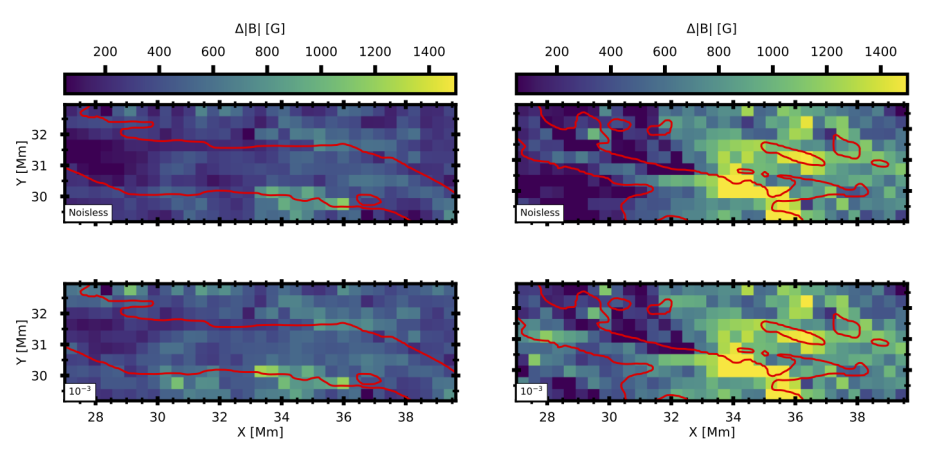
Difference between the total magnetic field strength inferred by the application of the WFA to the Mg II h and k line core and wings. The left column shows the result for the MFR and the right column for the SMA. The first row is the result for the noiseless case and the second row is the case of a synthetic observation with a polarimetric noise of 10^{-3} at the pseudo-continuum. The red contours delimit the boundaries of the cold plasma structure of the MFR or the SMA.