Research Highlights
Research Highlights
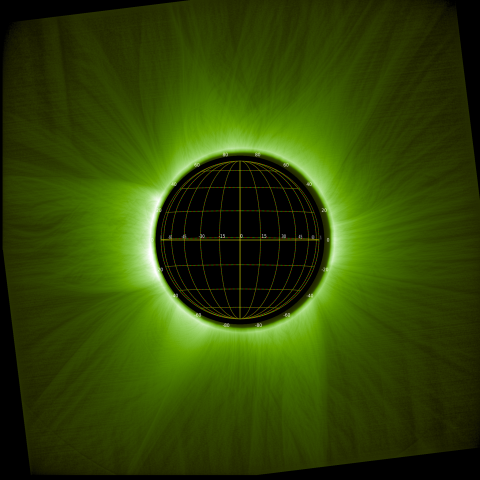
Observing the solar corona from a formation-flying mission. First results of Proba-3/ASPIICS
Sarah Gibson et. al., report the first results from observations of the solar corona by the (Association of Spacecraft for Polarimetric and Imaging Investigation of the Corona of the Sun) ASPIICS coronagraph aboard the Proba-3 mission.
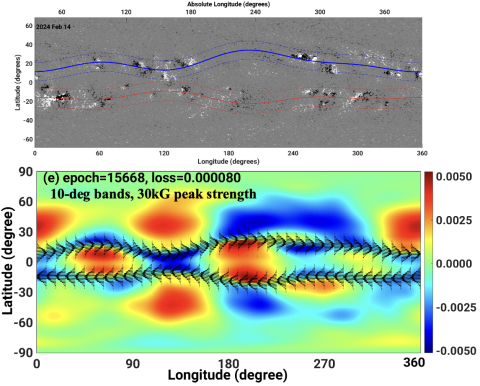
MHD-tachocline-model solutions of magnetic vectors
S. Chatterjee and M. Dikpati develop PINNBARDS, a novel Physics-Informed Neural Network (PINN)-Based AR Distribution Simulator, that uses observational toroids and MHD-SWT equations to derive initial state-vector. This framework provides the first plausible method for reconstructing state-vectors for hidden tachocline magnetic structures from surface patterns; this could potentially lead to accurate prediction of flare-producing AR-emergence weeks ahead.
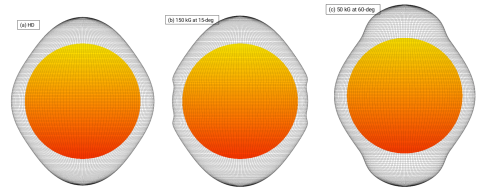
A Multi-layer Magnetohydrodynamic Shallow-water Model of The Solar Tachocline: Equilibrium Shape and Thickness
M. Dikpati and P. A. Gilman build a multi-layer MHD shallow-water model to study the thickness and shape of a the solar tachocline allowing them to include characteristics of both the overshoot and the radiative parts of the tachocline.
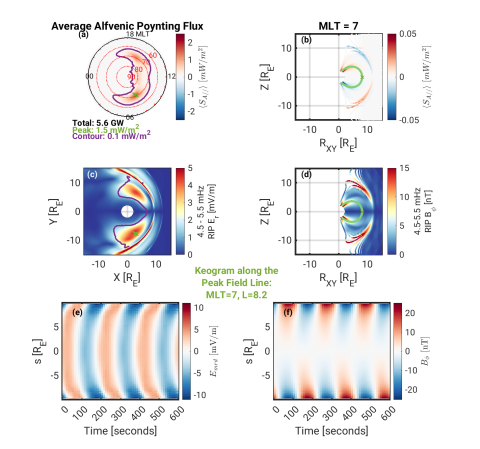
Efficiency of Electromagnetic Energy Transfer from Solar Wind to Ionosphere through Magnetospheric Ultra-Low Frequency Waves
Dong Lin, Michael Hartinger, William Lotko, Wenbin Wang, Xueling Shi, Bharat Kunduri, Viacheslav Merkin, Kareem Sorathia, Kevin Pham, and Michael Wiltberger perform idealized numerical experiments to investigate the electromagnetic energy flow in response to undulating solar wind. The theoretical study provides new understanding of the significance of the electromagnetic energy flow and its dependence on different parameters.
Polarimeter to Unify the Corona and Heliosphere (PUNCH)
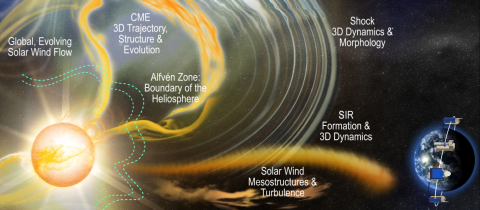
Sarah Gibson, et. al. present the two science objectives behind the Polarimeter to Unify the Corona and Heliosphere (PUNCH) mission: (1) understand how coronal structures become the ambient solar wind, and (2) understand the dynamic evolution of transient structures, such as coronal mass ejections, in the young solar wind. PUNCH is a NASA Small Explorer launched in March of 2025 and began science operations in June of 2025.
Behaviors of Interhemispheric Coupling in Different Boreal Winter Subseasons During Major SSWs
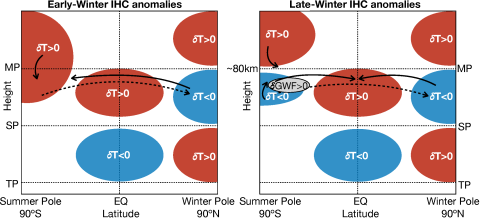
Zishun Qiao, Nicholas Pedatella, Alan Liu, Han-Li Liu, Joseph Mclnerney investigate the behaviors of the typical interhemispheric coupling (IHC) in different boreal winter subseasons during major sudden stratospheric warming (SSW).
Influence of the Stratospheric Quasi-Biennial Oscillation on the Seasonal Variation in the Mesosphere and Lower Thermosphere Based on a Long-Term Reanalysis JAWARA
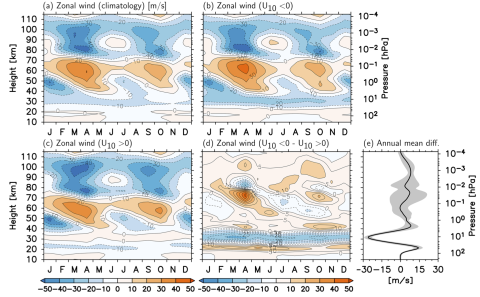
D. Koshin and K. Sato discuss the quasi-biennial oscillation (QBO) in terms of the semiannual oscillations (SAOs) around the stratopause and the mesopause, and the tides, using the long-term global reanalysis for the whole neutral atmosphere over 19 years of 2004–23.
Polarization fringes in optical systems: a compendium
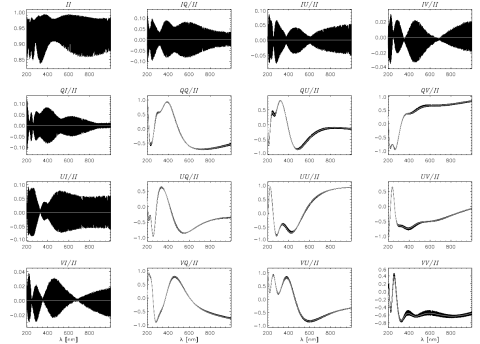
R. Casini and D. M. Harrington review the fundamental mechanisms that are responsible for instrumental artifacts that can affect the accuracy of optical designs conceived for high-sensitivity spectroscopy and polarimetry. Modeling examples are used to highlight the salient characteristics of polarization fringes, as well as to assess how approximate treatments such as this compare to exact but more computational expensive formulations of the problem such as Berreman's calculus.
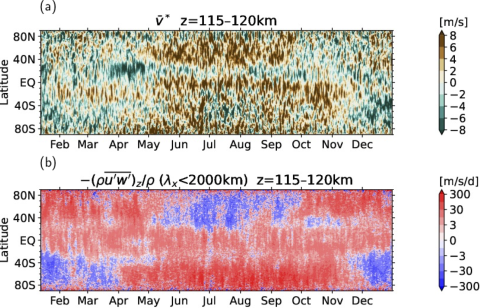
Contribution of Gravity Waves to the Lower Thermospheric Winter-to-summer Meridional Circulation in High-resolution WACCM-X
D. Koshin, N. M. Pedatella, A. K. Smith, and H.-L. Liu analyze the role of gravity waves contributing to winter polar region circulation using output from a high-resolution simulation. In the winter middle atmosphere, gravity waves with eastward phase speeds are generated around the polar vortex and propagate into the lower thermosphere.