The Astrophysical Journal: We build a multi-layer MHD shallow-water model to study the thickness and shape of a the solar tachocline. This allows us to include characteristics of both the overshoot and the radiative parts of the tachocline. The equations derived include equilibrium in latitude among Coriolis, pressure gradient and magnetic curvature stresses for each layer, and magnetohydrostatic equilibrium in the radial direction. In each layer the total mass is conserved; mass is redistributed for different amplitudes and latitude positions of toroidal bands, thus producing variations in tachocline shape and thickness with solar cycle phases. While we solve here for equilibrium of two layers, the equations can be readily generalized for additional layers. In pure hydrodynamic tachocline with no differential rotation, thickness and shape are independent of latitude. With differential rotation and/or magnetic fields, the tachocline is, in general, oblate in equatorial regions but prolate in polar latitudes. A local bump occurs at the poleward side of tachocline toroidal band. Hence, depending on latitude-location and amplitude of magnetic band as function of solar cycle, the local bump drifts equatorward trailing the magnetic field. Oblateness and prolateness are much larger in the overshoot than in the radiative layer, due to its lower effective gravity. Our results can provide guidance for interpreting helioseismic estimates of variations in tachocline shape and thickness in latitude, including upper limits to banded toroidal field amplitudes.
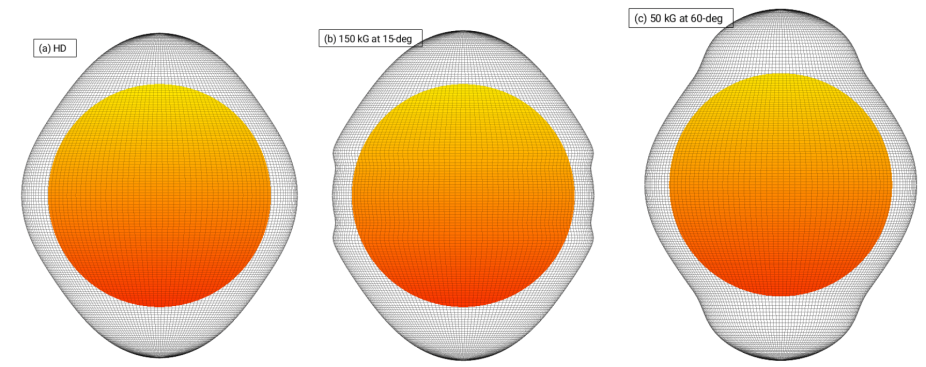
A few perspective spherical views of how tachocline shapes (semi-transparent mesh surface) would look like for a purely hydrodynamic situation (panel a), a 150 kG toroidal magnetic band of 10-degree latitudinal width residing in both layers at 15-degree latitude (panel b), and a 50 kG band with 10-degree latitudinal width at 60-degree latitude (panel c), but for G = 0.1. Tachocline layer is 100 times magnified to show the intricate details of how shape would vary in different cases. Note that tachocline is prolate in all cases.