Journal of Geophysical Research: Atmospheres: The typical interhemispheric coupling (IHC) pattern relating to a sudden stratospheric warming (SSW) event can be described as the teleconnection between the anomalously warm temperatures in the winter stratosphere and the warming in the high-latitude summer mesopause. While wave forcings and circulation changes are the possible mechanisms producing the IHC pattern, a detailed investigation separating the subseasonal changes may contribute to understanding these mechanisms. This study categorizes IHC events by their occurrence time with a focus on major northern hemisphere (NH) SSW events to explicitly differentiate their behaviors in early, mid-, and late boreal winter subseasons. 45 yrs SD-WACCM-X simulations and 22 yrs NASA Aura MLS observations are utilized, and reasonable data-model agreement is achieved. The typical IHC pattern is identified in all cases. The simulated residual mean circulation, parameterized GW forcing, and resolved planetary and tidal forcing represent intra-seasonal changes during major NH SSWs, which result in different behaviors of IHCs. In particular, an anomalous cooling below the summer mesopause at southern hemispheric high latitudes is identified in addition to the typical IHC pattern during late boreal winter subseasons and attributed to the consequences of changes in residual mean circulation and GW forcing due to upwelling effects.
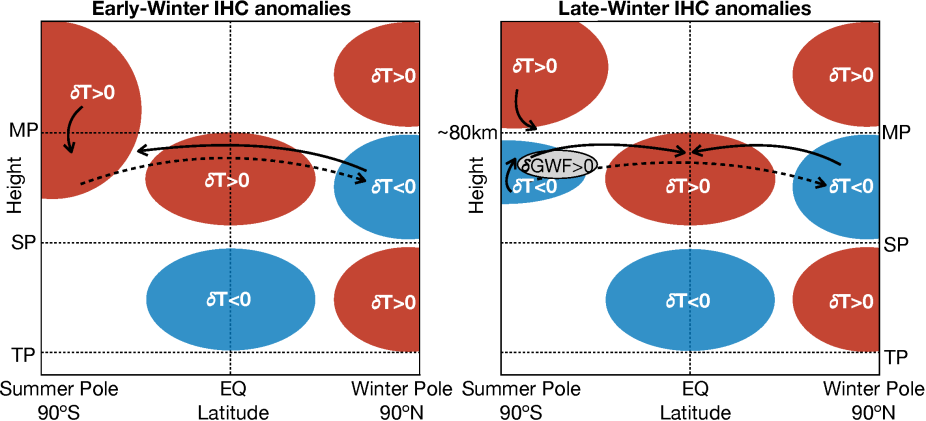
This figure shows that during IHC events associated with major Northern Hemisphere SSWs, circulation anomalies (solid arrows) and gravity-wave forcing anomalies in the high-latitude summer mesosphere have opposite signs in late boreal winter (right) compared with early winter (left).
This implies two possible mechanisms for the anomalous cooling below the summer mesopause at high latitudes during late-winter IHC events.