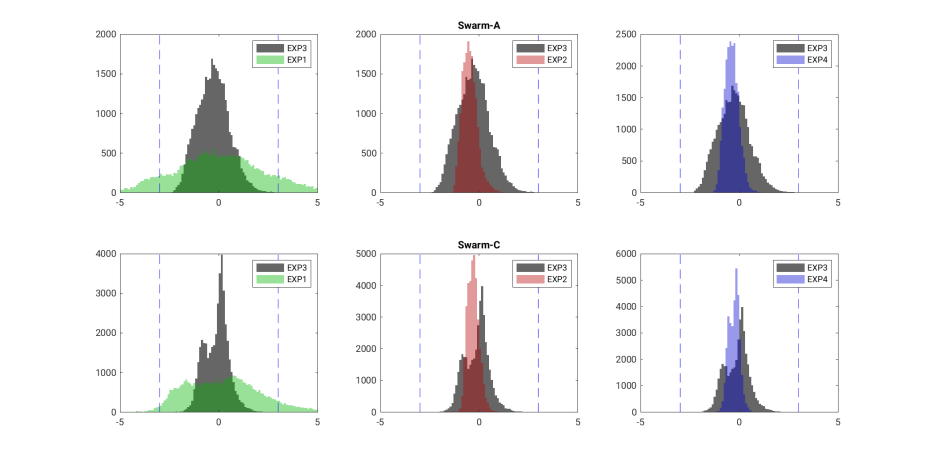
Histogram of the normalized model–data difference (Ai) for dayside Swarm neutral density. The grey histogram shows Ai computed from the WACCM-X ensemble using the new method (EXP 3). The green and red histograms represent Ai computed using the old method (EXP 1 and EXP 2). The blue histogram shows Ai computed with the new method, but with doubled spread (EXP 4). The top row presents the Ai distributions for Swarm-A, and the bottom row shows those for Swarm-C. Blue dashed lines indicate the ±3-standard-deviation thresholds.
Space Weather: This study investigates the sensitivity of the thermosphere and ionosphere to variations in solar spectral irradiance. Using data from the SDO and SORCE missions collected between 2010 and 2018, we quantified the variability and uncertainty of solar spectral irradiance across wavelengths from 0.1 to 190 nm and developed a data-driven method to generate perturbed versions of the irradiance. These perturbations were used to drive ensemble simulation experiments conducted during the 2021/2022 winter to assess sensitivity in the thermosphere and ionosphere. In addition to the experiment using statistically derived perturbations, three more ensemble experiments driven by different perturbation methods were also performed.
Results show that both neutral temperature and electron density are highly sensitive to uncertainty in solar spectral irradiance, especially above 200 km altitude. Electron density is particularly influenced by soft X-ray variability in the lower ionosphere. Comparisons with Swarm, ICON, and COSMIC-2 satellite observations confirm the performance of ensemble simulation experiments on capturing the realistic thermospheric and ionospheric variability. Among the experiments, the one driven by statistically derived perturbations produces ensemble spreads that best match the observed variability. This experiment shows good agreement with all three datasets, while the others tend to overestimate or underestimate the variability.
This work highlights the importance of accounting for uncertainty in external solar energy input in space weather models and demonstrates the value of data-informed ensemble simulations in improving the accuracy and reliability of thermosphere and ionosphere forecasts.