We describe the scientific objectives and instrument design of the ASPIICS coronagraph launched aboard the Proba-3 mission of the European Space Agency (ESA) on 5 December 2024. Proba-3 consists of two spacecraft in a highly elliptical orbit around the Earth. One spacecraft carries the telescope, and the external occulter is mounted on the second spacecraft. The two spacecraft fly in a precise formation during 6 hours out of 19.63 hour orbit, together forming a giant solar coronagraph called ASPIICS (Association of Spacecraft for Polarimetric and Imaging Investigation of the Corona of the Sun). Very long distance between the external occulter and the telescope (around 144 m) represents an increase of two orders of magnitude compared to classical externally occulted solar coronagraphs. This allows us to observe the inner corona in eclipse-like conditions, i.e. close to the solar limb (down to 1.099 Rs) and with very low straylight. ASPIICS will provide a new perspective on the inner solar corona that will help solve several outstanding problems in solar physics, such as the origin of the slow solar wind and physical mechanism of coronal mass ejections.
Paper in Astronomy and Astrophysics
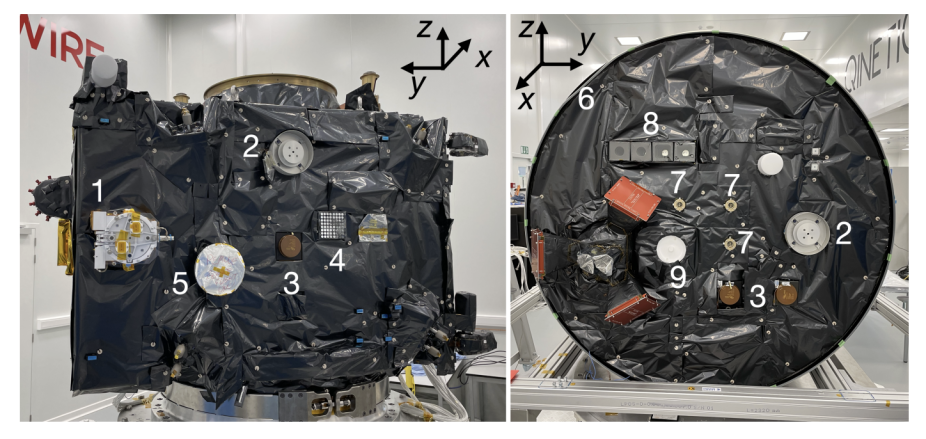
Two spacecraft of the Proba-3 mission. Left panel: the Coronagraph Spacecraft (CSC). Right panel: the Occulter Spacecraft (OSC). The annotations highlight key subsystems of the mission: the entrance door of the ASPIICS coronagraph (1), GNSS antennas (2), antennas of the Inter-Satellite Link (ISL, 3), some mires of the Visual-Based System (4), Corner Cube Retro-Reflector (5), which is a part of the Fine Lateral and Longitudinal Sensor (FLLS), the edge of the external occulter (6), three LEDs of the Occulter Position Sensor Emitter (OPSE, 7), wide-angle and narrow-angle cameras of the VBS (8), laser of the FLLS (9). The axes of the coordinate systems are shown in each panel, with the x-axis pointing away from the Sun, z-axis pointing towards the ecliptic north, and y-axis complementing the right-handed system. The theoretical formation corresponds to the perfect alignment of the respectively x, y, and z axes attached to the two spacecraft.