Geophysical Research Letters: We investigate diurnal variability in gravity wave activity, which is an indication of the interaction between gravity waves and tides. We use satellite observations covering almost all solar local times, to estimate the potential energy of gravity waves at each local time. In the equatorial region between 15°S and 15°N, a clear diurnal cycle is observed. This structure is attributed to the static stability associated with the diurnal tide. In the midlatitudes, at 15–60°N and 15–60°S, a semidiurnal variation is observed at altitudes above 90 km. This structure can also be explained by the static stability associated with the semidiurnal tide. These results are generally consistent with previous ground-based observations, although the spatial coverage of ground-based observations is limited. Thus, this study provides a global view of the interaction between gravity waves and tides in the real atmosphere.
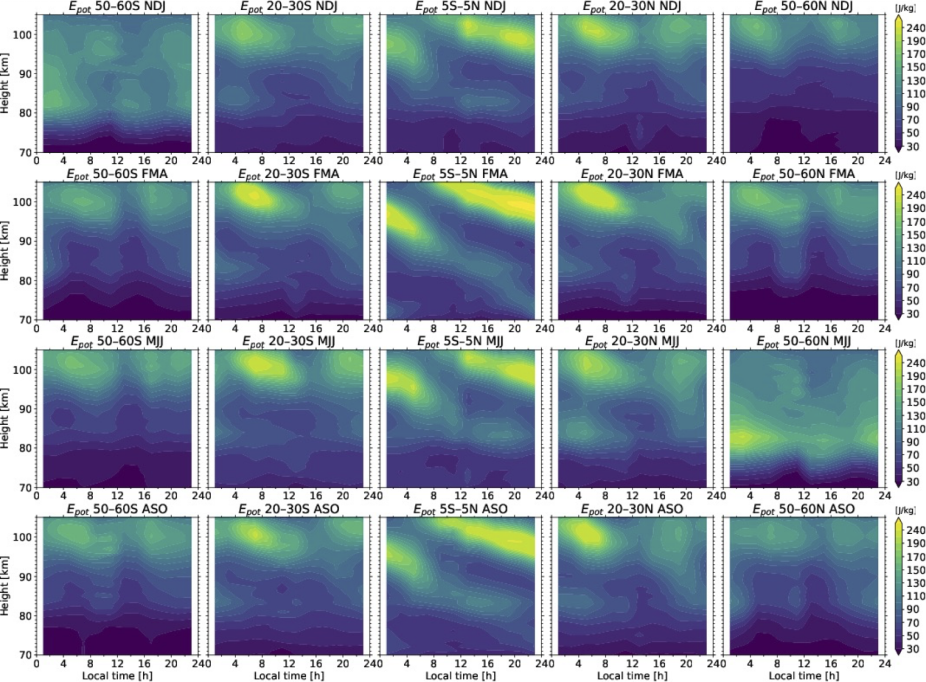
Local time-height section of the gravity wave potential energy derived from TIMED/SABER observations. The results are averaged for 50–60°S, 20–30°S, 5°S–5°N, 20–30°N, and 50–60°N (from left to right) for NDJ, FMA, MJJ, and ASO (from top to bottom). These results illustrate the significant local time variation in the gravity wave potential energy, and how it varies with season and latitude.