Authors: Alfred de Wijn, David Harrington, Roberto Casini
Solar physicists use instruments called polarimeters to measure the polarization of sunlight, which reveals the strength and structure of the Sun's magnetic field. Before a polarimeter can deliver reliable measurements, it must be calibrated by feeding known polarization states into the instrument. Calibration takes time, and telescope time is precious — particularly for solar telescopes, where intense sunlight limits how long calibration optics can safely remain in the beam. This raises a key question: what sequence of calibration measurements yields the most accurate result in a given amount of time?
In this paper, we introduce a mathematical framework to answer that question. We define a calibration efficiency — a measure of how effectively a calibration sequence converts measurement signal into knowledge about the instrument — directly analogous to the previously developed concept of modulation efficiency used to optimize how polarimeters encode polarization signals. Together, these two metrics provide a unified description of how noise propagates through a polarimetric measurement from start to finish. We apply the framework to design an optimized calibration scheme for a hypothetical broadband solar instrument covering 587–1083 nm, demonstrating that a compound two-retarder design achieves near-optimal calibration efficiency across the full wavelength range simultaneously.
Paper at the Journal of the Optical Society of America
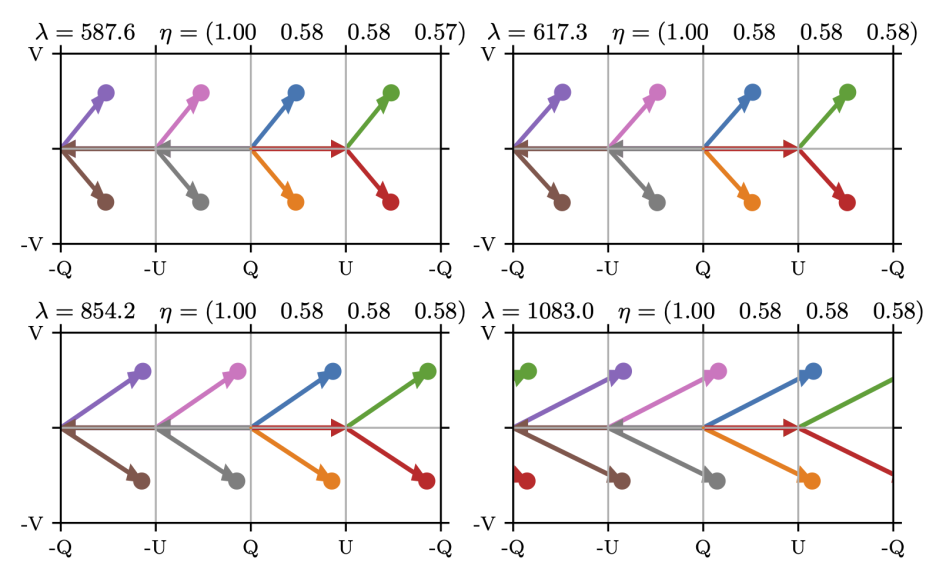
Calibration states generated by the optimized two-retarder scheme at four wavelengths spanning 587–1083 nm, shown as projections onto the Poincaré sphere — the standard geometric representation of polarization states. Each point represents a distinct input polarization state used during calibration; arrows indicate the sequence in which they are produced. The reported calibration efficiencies η show that the scheme achieves near-optimal performance simultaneously at all wavelengths, analogous to the broadband modulation efficiency already used in the design of modern solar polarimeters.