Authors: Robert Jarolim, Martin Sanner, Chia-Man Hung, Emma Stevenson, Hala Lamdouar, Josh Veitch-Michaelis, Ioanna Bouri, Anna Malanushenko, Elena Provornikova, Vít Růžička, Carlos Urbina-Ortega
Coronal mass ejections (CMEs) are large eruptions of plasma from the Sun that can affect space weather near Earth. Coronagraphs observe these eruptions by measuring sunlight scattered by electrons in the solar corona and heliosphere. However, these images are two-dimensional projections of a three-dimensional structure, which makes it difficult to determine the true shape, density, and motion of a CME.
We introduce SuNeRF-CME, a new method for reconstructing the three-dimensional plasma structure of CMEs from coronagraph images taken from multiple viewpoints. The method uses neural radiance fields, a machine-learning technique that represents the electron density as a continuous 3D model. The model is connected to the physics of Thomson scattering, which describes how sunlight is scattered by free electrons. We also include physical constraints on plasma continuity, propagation direction, and speed to improve the reconstruction when only a small number of viewpoints is available.
We test the method using synthetic coronagraph images generated from a CME simulation, where the true 3D plasma structure is known. This allows us to quantify the accuracy of the reconstruction. In this controlled test, SuNeRF-CME recovers CME properties reliably from only two viewpoints, with an average velocity error of about 3% and propagation-direction errors of only a few degrees. The method also reconstructs important structural features of the CME, including its three-part structure, distorted front, and internal density variations.
These results show that physics-informed neural radiance fields are a promising approach for CME tomography. The method can naturally incorporate additional viewpoints when available and provides a path toward applying 3D CME reconstructions to real observations and future space-weather forecasting.
Paper at The Astrophysical Journal
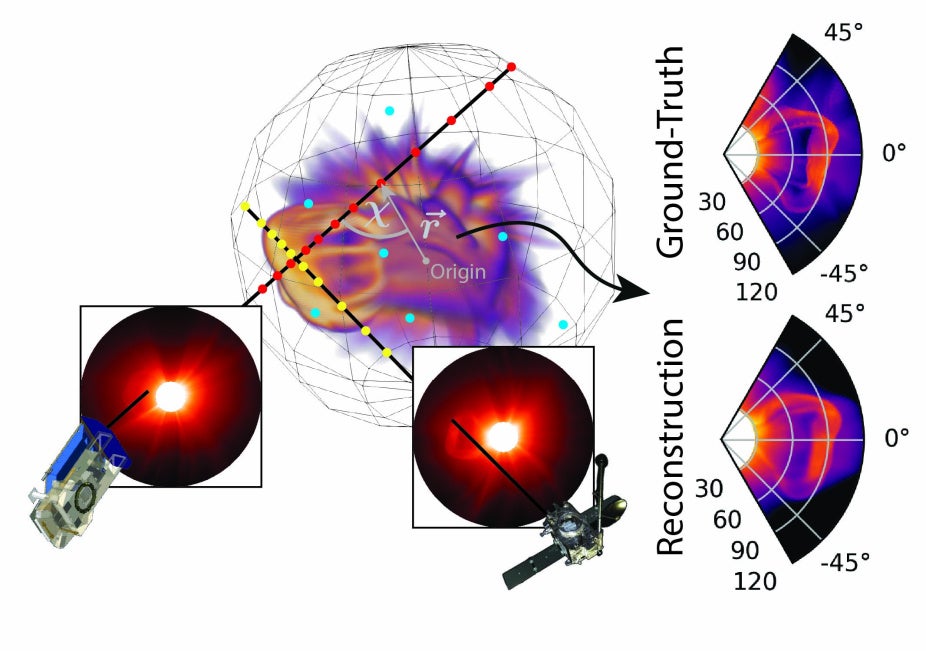
Overview of the SuNeRF-CME reconstruction approach. Coronagraph images from multiple viewpoints provide different two-dimensional views of the same coronal mass ejection. SuNeRF-CME combines these views into a three-dimensional model of the CME plasma and adjusts the model until the simulated images match the input observations. The reconstructed CME structure can then be compared with the known simulation ground truth, showing that the method recovers the main propagation direction, overall shape, and internal plasma structure from only two viewpoints.