Authors: Robert Jarolim, João M. da Silva Santos, Matthias Rempel, Marianna B. Korsós, Robertus Erdélyi, Astrid Veronig, Szabolcs Soós, and David Kuridze
Solar eruptions are powered by magnetic energy stored in the Sun’s atmosphere, but the magnetic structure that exists before an eruption is difficult to determine. In particular, scientists debate whether solar filaments are supported by pre-existing, twisted magnetic flux ropes or by less twisted magnetic arcades that form flux ropes only during eruption. We developed a physics-informed method that reconstructs the three-dimensional magnetic field using measurements from both the Sun’s visible surface and the chromosphere above it. Tests with realistic solar simulations show that adding chromospheric measurements substantially improves the reconstruction and can prevent the magnetic configuration from being misidentified. Applied to observations from the Swedish Solar Telescope, the method reveals that the studied filament was supported by a magnetic flux rope before it began to erupt. This approach provides a new way to investigate how magnetic energy is stored and what causes solar eruptions.
Paper at The Astrophysical Journal Letters
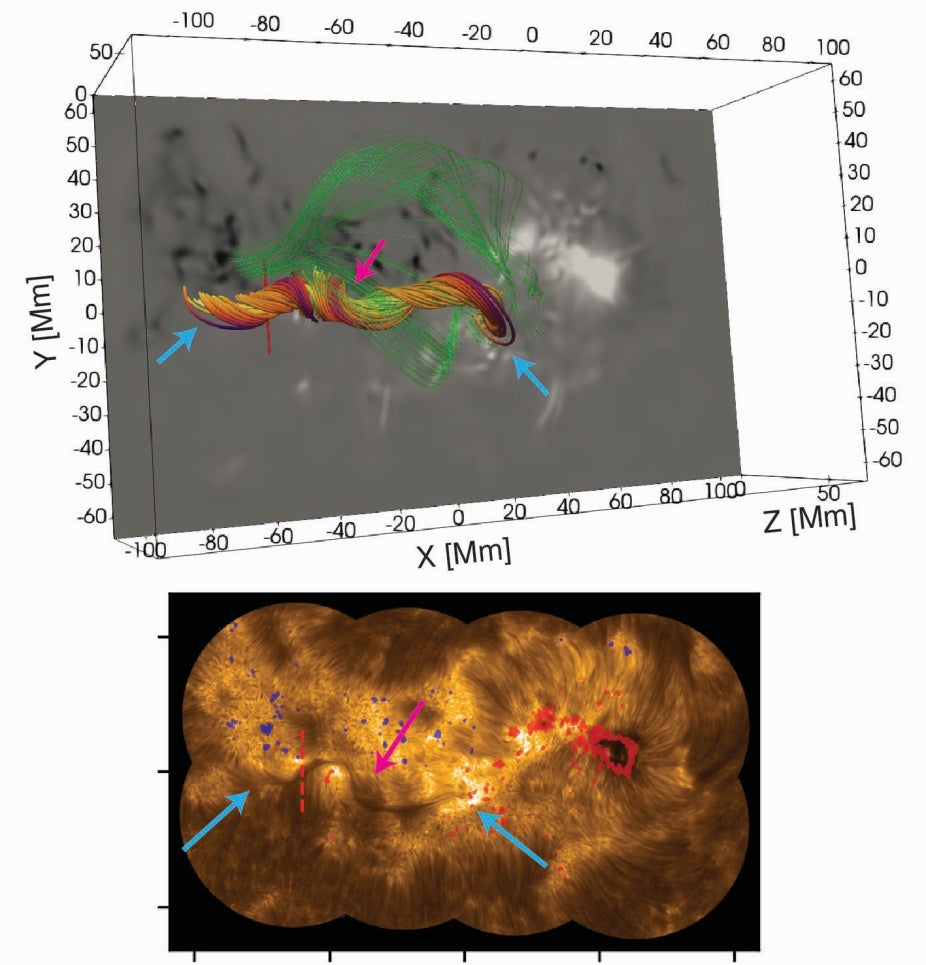
The reconstructed three-dimensional magnetic field supporting a solar filament (top) and the corresponding filament observed by the Swedish Solar Telescope (bottom). The colored curves trace the twisted, current-carrying magnetic structure, while the green curves show the overlying magnetic field. By combining magnetic measurements from the photosphere and chromosphere, the reconstruction reveals that the filament was supported by a pre-existing magnetic flux rope before its eruption.