JGR Space Physics: The upper atmosphere (F-region ionosphere, ~300 km above Earth) is influenced by changes that occur much lower in the atmosphere (∼30 km), including dramatic disruptions in the winter stratospheric polar vortex known as sudden stratospheric warming (SSW) events. This study examines how a major SSW in 2020-2021 affected global atmospheric waves called lunar tides. These tides, caused by the Moon’s gravitational pull, are well understood in the neutral atmosphere, globally distributed. Using electron density data from the COSMIC-2 satellite (GIS), vertical plasma drifts from NASA’s ICON mission, and simulations from the SD-WACCM-X and TIE-GCM model, we found that lunar tides became stronger in the ionosphere (region critical for radio communication and GPS systems). Our results show that the E-region dynamo acts as a key electrodynamic link, allowing stratospheric weather changes to influence conditions much higher up. Understanding this connection helps to improve our ability to forecast space weather and protect the technology we rely on every day.
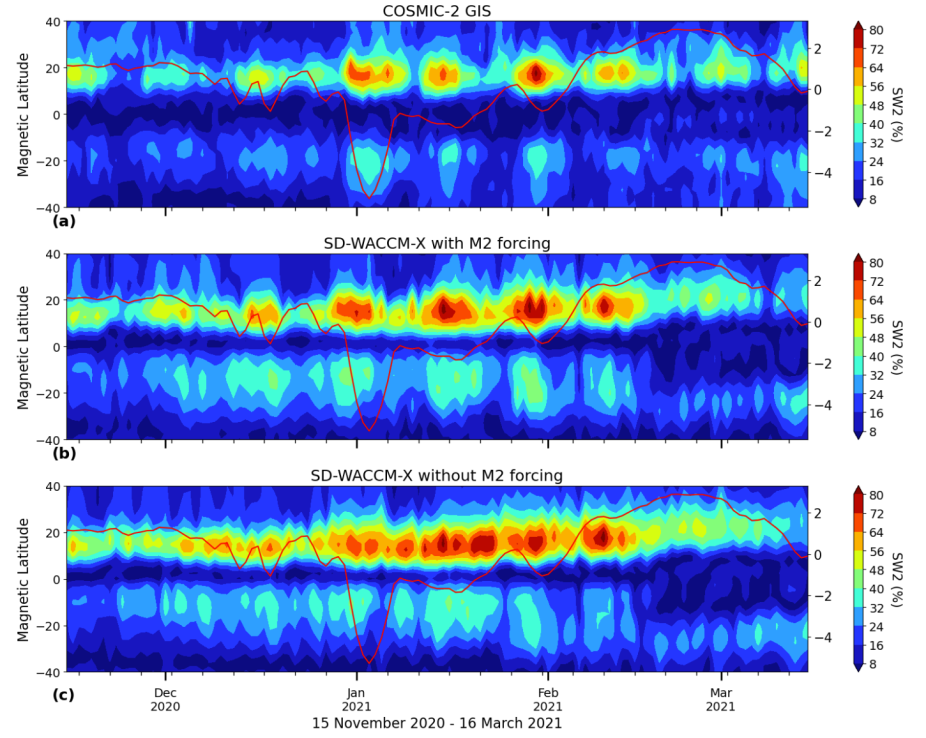
(a) Semidiurnal tide (SW2) relative amplitudes (%) using COSMIC-2 GIS electron density from 15 November 2020 - 15 March 2021 at 300 km. (b) Same as (a) but for SD-WACCM-X (with M2 forcing), and (c) SD-WACCM-X (without M2 forcing). Over-plotted red line is the Northern Annular Mode (NAM) index at 1hPa. The relative amplitudes are with respect to running 27 day zonal mean at each latitude and altitude. The results show good agreement between the SW2 in COSMIC-2 and SD-WACCM-X, especially when the lunar tide (M2) forcing is included.