Authors: Hongyang Luo, Yuhong Fan
Solar prominences are cool, dense condensations suspended in the million-degree corona by stressed magnetic fields. Because these fields store free magnetic energy before space-weather-relevant eruptions, prominence morphology provides a visible probe of otherwise hidden pre-eruptive coronal structure. A persistent observational puzzle is why filament barbs, the lateral extensions of prominences, show a preferred bearing linked to the chirality of the filament channel. Here we use a three-dimensional magnetohydrodynamic simulation of a condensation-formed prominence in an emerged flux rope to show that barb chirality arises from the coupling of helical magnetic geometry and magnetic Rayleigh--Taylor interchange. Cool plasma accumulates in skewed flux-rope dips, causing the rope handedness to set the projected barb bearing. Meanwhile, density inversions at the prominence-corona boundary trigger localized interchange motions that continually restructure the barb-bearing lower boundary. Synthetic EUV emission shows persistent right-bearing barbs in a left-handed flux rope, consistent with the observed morphology of dextral filament channels. These results establish filament barbs as observable signatures of hidden flux-rope helicity and show how magnetic topology regulates gravity-driven interchange in magnetically confined astrophysical plasmas.
Paper available in The Astrophysical Journal Letters.
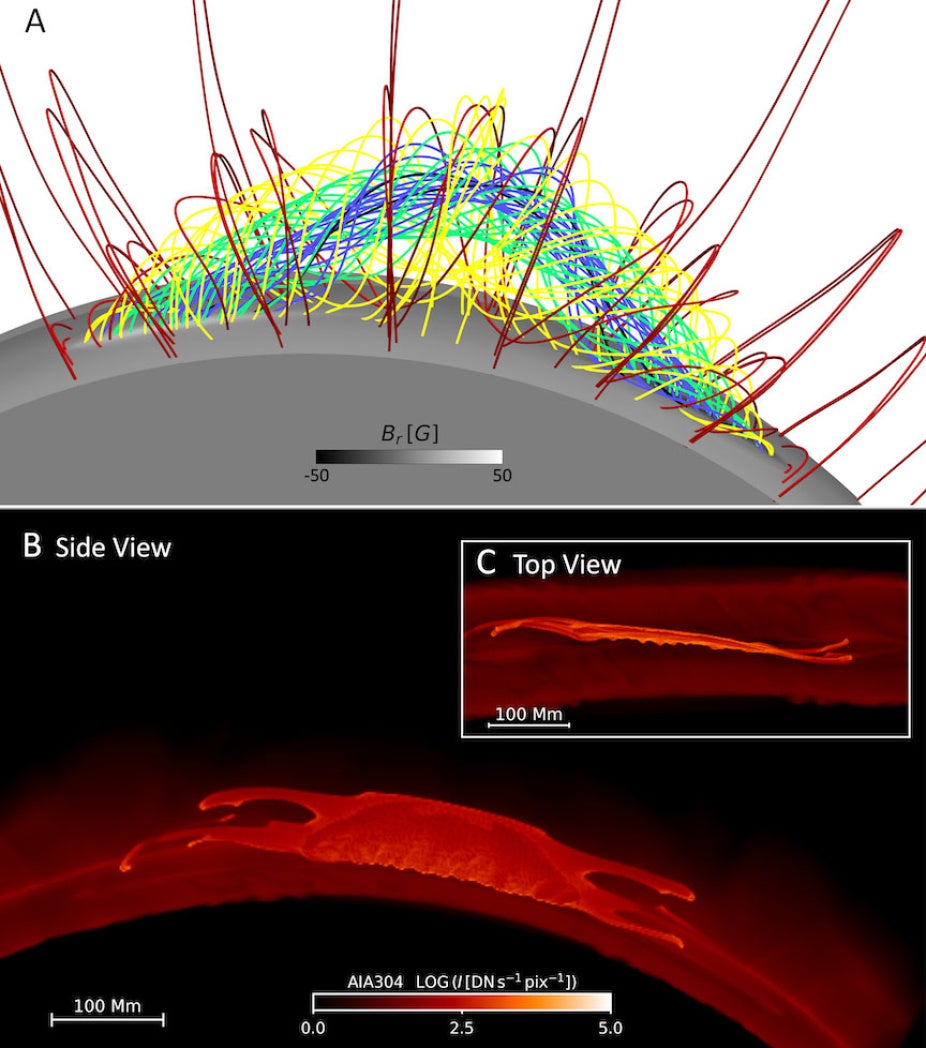
MHD simulation of a prominence-forming coronal flux rope. (A) Magnetic field lines of the flux rope confined beneath the overlying coronal streamer field. Synthetic SDO/AIA 304 Å emission reveals a vertically extended prominence sheet in the side view (B) and a barb-bearing filament in the top view (C).