Journal of the Optical Society of America: We review the algebraic definition of the efficiency of a polarization modulation scheme, which is commonly adopted for solar and stellar spectro-polarimetry applications, and generalize it to allow distinct states of the modulation cycle to have arbitrary throughput and different photon-noise statistics for each state.
Such a generalization becomes necessary to model and optimize the polarimetric efficiency of instruments implementing spatial polarization modulation schemes, where different optical paths are assigned to different polarization analysis states, which may be characterized by different throughput values.
The proposed algebraic extension is also applicable to the concept of the efficiency of a polarization calibration scheme, which can then be used to create a merit function for the optimization of calibration sequences, which take into account the specific characteristics of the polarimetric instrument and of its calibration optics.
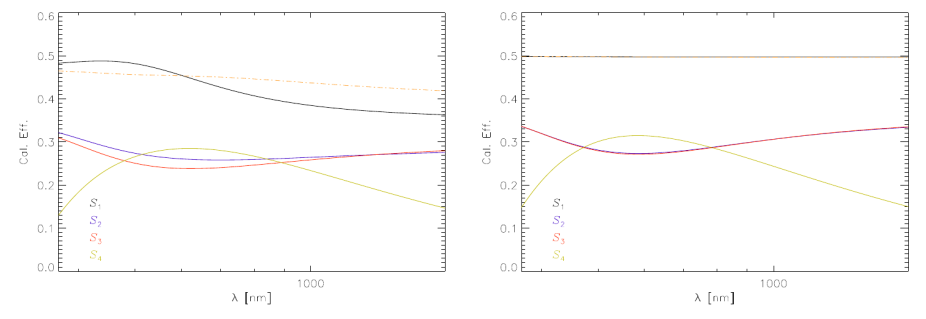
Calibration efficiency plots between 370 and 1700 nm for the DKIST optically contacted SiO2 calibration retarder, assuming an optimally efficient and balanced 4-state polarization modulator. Colored curves show 𝑆_1 (black), 𝑆_2 (blue), 𝑆_3 (red), and 𝑆_4 (green). The yellow dot-dashed curve corresponds to the RSS of the 𝑆_{2,3,4} efficiencies. Left: Using one of the calibration sequences currently implemented at the DKIST (left panel of Table 2). Right: After optimization of the DKIST sequence, resulting in the calibration sequence in the center panel of Table 2 (see caption of Table 2 for details); we note that the curves for the linear polarization parameters 𝑆_2 and 𝑆_3 are overlapping, and the RSS of the 𝑆_{2,3,4} efficiencies is essentially identical to the efficiency of 𝑆_1, demonstrating the optimal performance of the calibration sequence for this retarder. We note that the maximum efficiency tops at 1/2, because of the adopted normalization Eq. (30) in the definition of calibration efficiency, and from having assumed an ideal calibration linear polarizer with 50% transmission.