Authors: D. Afonso Delgado, R. Casini, R. Centeno
We address the need to model the effects of radiation anisotropy and atomic coherence on the Stokes profiles of magnetically-sensitive lines formed in the solar chromosphere. Accounting for the physics of scattering polarization associated with these effects, and how they map to the strength and direction of weak magnetic fields on the Sun is a formidable computational task when done fully self-consistently. This has hindered the broad heliophysics community from gaining prompt access to reliable data products from solar facility spectro-polarimeters concerning quiet-Sun magnetism.
We present a computationally simple yet sufficiently accurate numerical approximation of the linear polariza- tion from resonance scattering and the Hanle effect in chromospheric lines that are formed in the regime of complete frequency redistribution. The method relies on both assumptions of weak magnetic field and weak anisotropy of radiation in the atmospheric layer where the line core is formed, and which is approximated as a homogeneous slab. We tested this approximation on the Ca II line of the IR triplet at 854.2 nm, which is a popular diagnostic of chromospheric activity, and a frequent target of observing proposals at major solar observatories such as the NSF Daniel K. Inouye Solar Telescope. We demonstrate that the proposed approximation can effectively be used to correct the synthesis of Stokes profiles from forward/inversion codes that do not natively implement the physics of scattering polarization, so that spectro-polarimetric inversions run with these codes can become quantitatively more accurate in the inference of weak magnetic fields in the solar chromosphere.
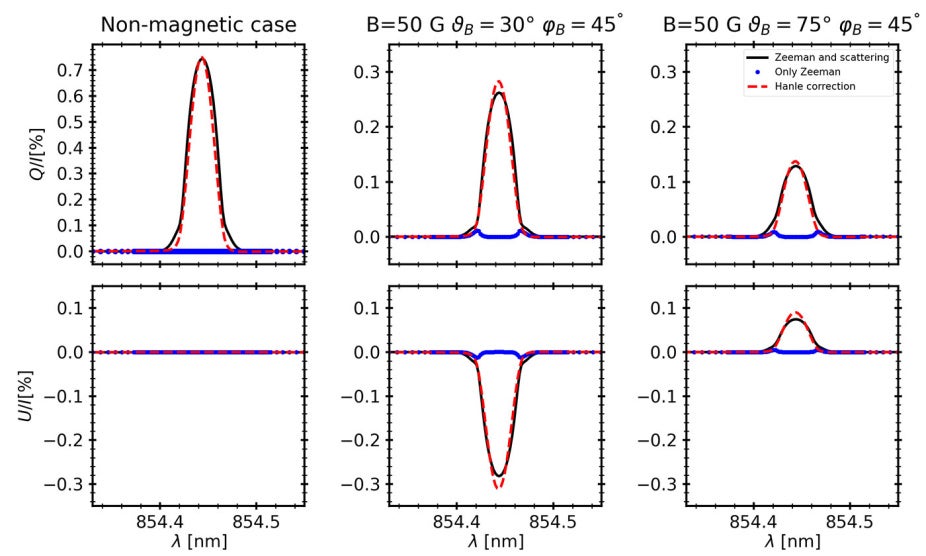
Comparison of Stokes Q/I (upper row) and Stokes U/I (bottom row) profiles computed using the full self-consistent calculation with HanleRT (solid black), modeling only the Zeeman effect (dotted blue), and calculated with the proposed methodology described in Sec. 2.2 (dashed red). The left panels show the results in the absence of a magnetic field, while the other two panels show the case of a magnetic field with B = 50 G, and two different inclinations from the radial direction, ϑB = 30◦ (central panels), and ϑB = 75◦ (right panels), for the same field azimuth φB = 45◦.