Authors: Dai Koshin, Nick Pedatella, and Hanli Liu
The electron density profile in the ionosphere is affected by neutral winds, through motion following the geomagnetic field. When the wind is poleward, the ionospheric plasma shifts downward. This relation can be used to estimate the wind, for which there are quite limited observations, while there are a large number of electron density profile observations from ground-based instruments and satellites. First, we derived a new theoretical formula that connects the relation between the difference in ionospheric height and the magnetic field aligned wind. The result is consistent with previous studies, but it also suggests latitudinal variations that were not previously indicated. Second, we validated this formula using outputs from a realistic whole atmosphere model. The results of the correlation between the ionospheric height differences and magnetic field aligned winds, and their latitudinal variations are generally consistent with the theoretical explanation. However, we also found several limitations in the current method that can introduce uncertainty in wind estimation.
Paper in JGR Space Physics
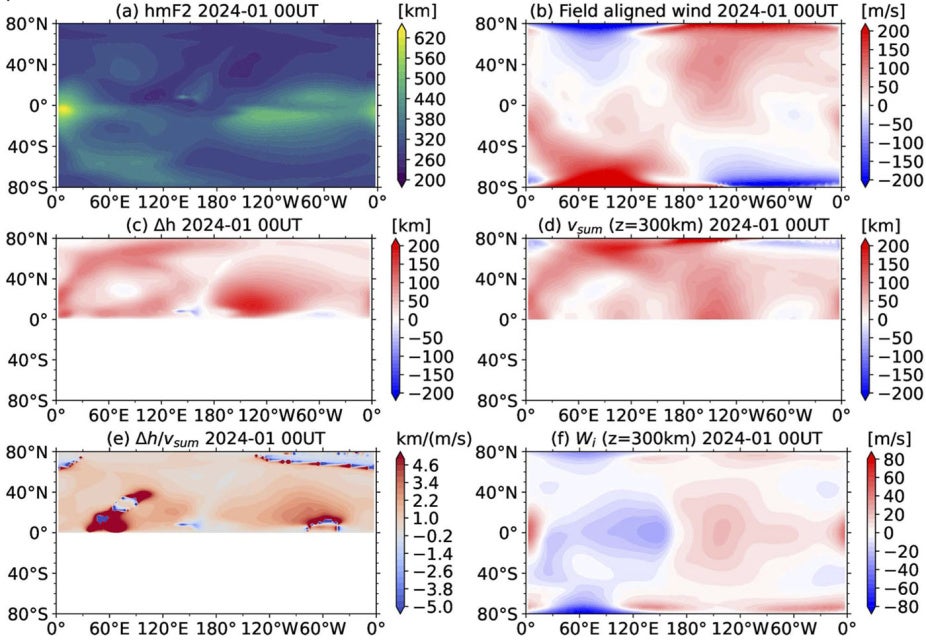
Horizontal distribution of (a) hmF2 height, (b) magnetic field aligned wind, (c) hmF2 height difference (Δℎ = ℎ − ℎ ), (d) sum of magnetic field aligned winds in the NH and SH, and (e) the ratio between them. The vertical ion drift is shown in (f). All variables are the monthly mean for January 2024 at 00UT in geomagnetic coordinates, and the winds are at z = 300 km.