Authors: Zihao Yang, Yuhong Fan, Giuliana de Toma, Sarah Gibson, and Matthias Rempel
The magnetic field of the solar corona plays a fundamental role in solar activity and space weather, yet measuring it over large regions remains challenging. Two-dimensional (2D) coronal seismology offers a promising approach by using ubiquitous propagating transverse waves to map the coronal magnetic field. However, because the corona is optically thin, observations integrate contributions from multiple structures along the line of sight, raising a fundamental question: what physical quantities do these measurements actually represent? Here we use a global magnetohydrodynamic simulation with self-consistently driven Alfvén waves to synthesize coronal spectroscopic observations and investigate how LOS integration affects the inferred plasma properties. We find that the diagnosed density and wave propagation direction are well represented by LOS emissivity-weighted averages. In contrast, the measured phase speed depends not only on emissivity but also on the distribution of wave velocity amplitudes along the LOS. Consequently, the inferred magnetic field is better described by an effective quantity that accounts for both effects, particularly in regions with complex coronal structures. These findings clarify the physical interpretation of 2D coronal seismology measurements and provide guidance for future coronal magnetic-field diagnostics and tomographic reconstructions.
Paper available at The Astrophysical Journal
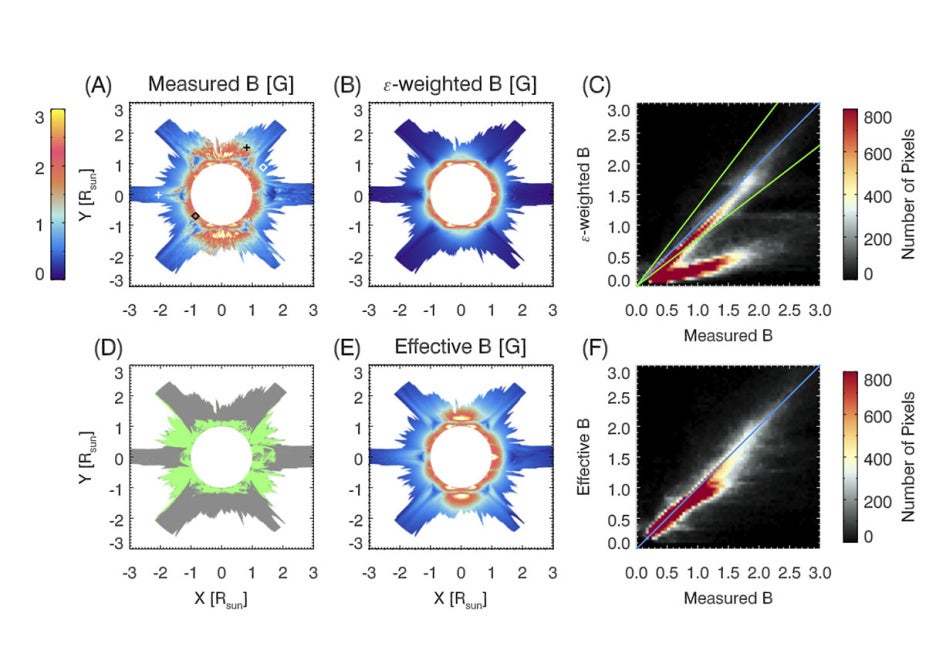
Comparison of coronal magnetic-field strengths inferred from synthetic observations using 2D coronal seismology (A) with reference quantities from a global MHD simulation. The line-of-sight emissivity-weighted magnetic field (B) shows substantial discrepancies from the inferred field in some regions, as illustrated by the scatter distribution (C) and spatial agreement map (D). An effective magnetic field that additionally accounts for wave velocity amplitudes (E) provides a much closer match to the inferred field (F), demonstrating the importance of amplitude-dependent line-of-sight effects in coronal magnetic-field measurements.