The Astrophysical Journal Supplement: We describe the numerical algorithms of a global magnetohydrodynamic (MHD) code utilizing the Yin-Yang grid, called the Yin-Yang Magnetic Flux Eruption (Yin-Yang-MFE) code, suitable for modeling the large-scale dynamical processes of the solar corona and the solar wind. It is a single-fluid MHD code taking into account the non-adiabatic effects of the solar corona, including the electron heat conduction, optically thin radiative cooling, and empirical coronal heating. We describe the numerical algorithms used to solve the set of MHD equations (with the semi-relativistic correction, or the Boris correction) in each of the partial spherical shell Yin Yang domains, and the method for updating the boundary conditions in the ghost-zones of the two overlapping domains with the code parallelized with the message passing interface (MPI). We validate the code performance with a set of standard test problems, and finally present a solar wind solution with a dipolar magnetic flux distribution at the solar surface, representative of solar minimum configuration.
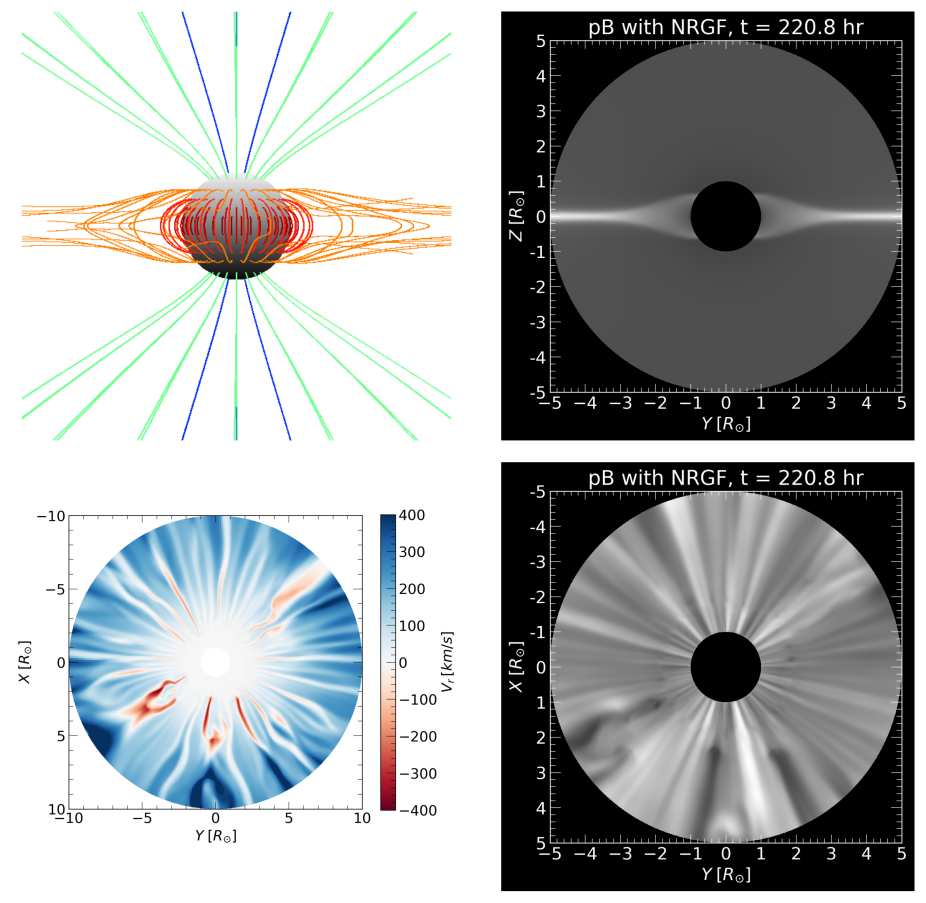
The quasi-steady state solution from a global MHD simulation of the solar wind with a dipolar magnetic field, representative of the solar minimum condition. The magnetic field has reached a partially open configuration (top left panel) with open field lines (green and blue field lines) in the high latitude polar regions and closed field lines (red field lines) in the equatorial region under cusped field lines (orange field lines) which extend into an equatorial heliospheric current sheet (HCS). A transonic outflow reasonably close to the outflow in solar minimum coronal hole (Withbroe 1988) is obtained in the open field region. The synthetic white-light coronagraph image as would be observed from the equatorial earth view (top right panel) shows the bright equatorial helmet streamers made up by the closed and the cusped magnetic field lines and the dark coronal holes in the polar region made up by the open magnetic field, representative of the configuration typically seen in coronagraph (or eclipse) images during solar minimum. On the other hand, the synthetic coronagraph image as viewed from the pole (bottom right panel) shows striking dynamic features in the HCS due to the on-going 3D magnetic reconnection in the HCS. They show elongated dark (under-dense) wiggly features flowing sunward and truncate at the top of the helmet streamer. These features correspond to strong reconnection jets flowing sunward from the reconnection sites (see the red sunward flows of 𝑣𝑟 in the equatorial plane shown in the bottom left panel).