Upcoming Events
Colloquium: Exploring Flare Dynamics in the Lower Solar Atmosphere with Multiline Observations - Oct 7, 2026
Colloquium: Coronal Cavities: A Survey Across the Solar Cycle - Oct 13, 2026
Colloquium: Ubiquitous Kelvin-Helmholtz Instabilities in the Solar Photosphere - Oct 14, 2026
Latest Research Highlights
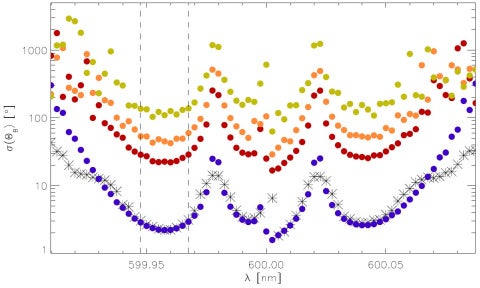
Error Propagation from Integral Moments and Spectral Derivatives of Stokes Profiles to Magnetic Observables
Aims: To derive convenient analytic estimations of magnetic inference errors, which can be used to inform and facilitate the creation of the science-traceability matrix of a polarimetric instrument.
Methods: We study the general problem of the propagation of Poissonian noise in polarized light signals to derived data products of the Stokes profiles, namely integral moments of arbitrary orders and spectral derivatives of the intensity. In particular, we derive the errors on the longitudinal and transversal projections of the magnetic field inferred from the weak-field approximation (WFA) of the Zeeman effect.
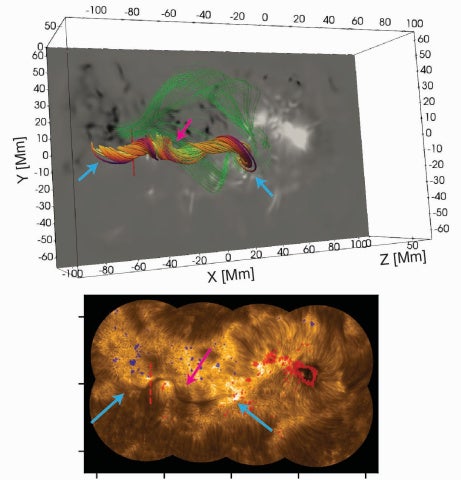
Chromospheric Magnetic Field Extrapolations Reveal the Flux-rope Configuration of a Solar Filament
Solar eruptions are powered by magnetic energy stored in the Sun’s atmosphere, but the magnetic structure that exists before an eruption is difficult to determine. In particular, scientists debate whether solar filaments are supported by pre-existing, twisted magnetic flux ropes or by less twisted magnetic arcades that form flux ropes only during eruption. We developed a physics-informed method that reconstructs the three-dimensional magnetic field using measurements from both the Sun’s visible surface and the chromosphere above it.
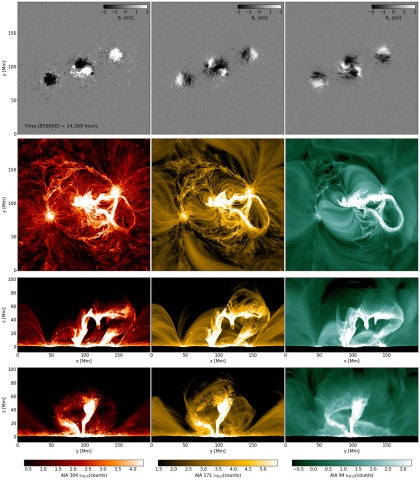
Data-inspired simulation of AR 11158
We present a data-inspired simulation of NOAA active region AR 11158. We simulate the formation of a collisional polarity inversion line (cPIL) by moving sunspots in a quadrupolar configuration along the centroid positions extracted from AR 11158. This process builds up free energy in the corona exceeding 4 × 10³² erg, out of which about 2 × 10³² erg are released in an X-flare followed by a series of smaller flares in the B to M range.
Latest News
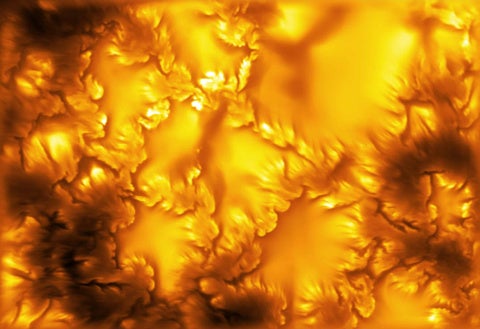
Scientists announce discovery of a hidden solar process
An international team of scientists, including HAO scientist Matthias Rempel, has announced the discovery of Kelvin-Helmholtz instability (KHI) in the form of small, swirling, whirlpool-like patterns on the surface of the Sun. The research indicates that KHI might be a key reason why the Sun's outer atmosphere gets so hot, and why magnetic energy builds up and moves around on the Sun, ultimately fueling solar flares and eruptions that can affect Earth.

HAO Interim Director, Mike Wiltberger
We welcome Dr. Mike Wiltberger as HAO Interim Director. His 22 years at HAO, combined with his scientific expertise and inter‑agency experience at NSF, make him exceptionally well prepared for this leadership role.
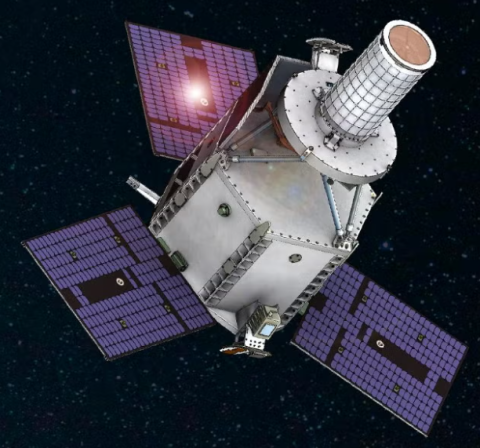
NASA selects NSF NCAR Heliophysics Mission for Continued Development
In December 2025, NASA selected the Chromospheric Magnetism Explorer (CMEx) for an extended period of concept development. The $150 million mission would fill a critical solar observational gap, generating information on conditions that lead to solar eruptions, advancing our knowledge of the solar magnetic field, and improving space weather modeling capabilities. It would also be the first Explorer-sized spacecraft mission ever led by NSF NCAR.