Main navigation

U.S. NSF Logo
NSF NCAR Logo
Contact Us
High Altitude Observatory
  • Home
  • About
    • HAO News
    • History of HAO
    • People
    • Visitor Program
    • Partnerships
    • Organizational Chart
    • Strategic and Implementation Plans
    • External Advisory Committees
    • Internal Advisory Committees
    • Information for Staff/Visitors
    • Computer Support
  • Research
    • Research Highlights
    • Science Topics
  • Modeling
    • Assimilative Mapping of Ionospheric Electrodynamics (AMIE)
    • Coupled Magnetosphere Ionosphere Thermosphere Model (CMIT)
    • Data-Optimized Coronal Field Model (DOCFM)
    • FORWARD
    • The GLobal airglOW Model (GLOW)
    • Global Scale Wave Model (GSWM)
    • Lyon-Fedder-Mobarry (LFM) code
    • MURaM Sunspot Model Output
    • TIEGCM
    • WACCM-X
    • Living With A Star Focus Team
  • Observation
    • Mauna Loa Solar Observatory
    • COSMO
    • Community Spectro-polarimetric Analysis Center
    • Fabry-Perot Interferometers
    • HAO Eclipses
    • McIntosh Synoptic Map Archive
    • NCAR Vacuum Tunnel Facility
    • Solar Maximum Mission
    • The Sun Today
    • WindCube
    • LFDI
  • Education
    • The Sun: A Pictorial Introduction
    • Questions and Answers About the Sun
    • Solar Physics Historical Timeline
    • Famous Solar-Stellar Scientists
    • Solar Astronomy in the Prehistoric Southwest
    • Suggested Reading
    • Additional Educational Resources
  • News & Events
    • News
    • All Upcoming Events
    • Past Events
Contact Us

Observing and Modeling the Sun-Earth System

What We Do

Latest News

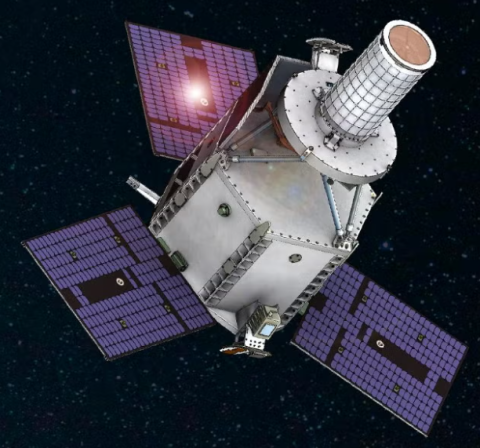
CMEx explorer mission

NASA selects NSF NCAR Heliophysics Mission for Continued Development

Dec 12, 2025

NASA has selected the Chromospheric Magnetism Explorer (CMEx) for an extended period of concept development. The $150 million mission would fill a critical solar observational gap, generating information on conditions that lead to solar eruptions, advancing our knowledge of the solar magnetic field, and improving space weather modeling capabilities. It would also be the first Explorer-sized spacecraft mission ever led by NSF NCAR.
sunspot image

New AI Based Methods for 3D Reconstruction of the Solar Photosphere

Dec 11, 2025

In a collaborative effort researchers at the University of Hawaii Institute for Astronomy (IfA), the NSF funded National Solar Observatory and NSF NCAR’s High Altitude Observatory developed a new artificial intelligence based method to reconstruct the magnetic field in the solar atmosphere.

Sunspot Image by KIS

International & European news agencies feature Sunspot research

Aug 13, 2025

The journal Astronomy & Astrophysics recently published a study on the development of a new method for analyzing the stability of sunspots. As part of this study, an international team—led by scientists from Germany in collaboration with colleagues from Sweden, the U.S. and Spain—applied this new method to observations with the German GREGOR solar telescope.

More News >>

Latest Research Highlights

Histogram: dayside Swarm neutral density

Quantifying the Impact of Solar Irradiance Uncertainty on Thermosphere-Ionosphere Variability Using Ensemble Forecasts

Dec 30, 2025

Using data from the SDO and SORCE missions collected between 2010 and 2018, Chih-Ting Hsu and Nicholas Pedatella investigate the sensitivity of the thermosphere and ionosphere to variations in solar spectral irradiance. 

Time-latitude sections for small scale waves

Contribution of Gravity Waves to the Lower Thermospheric Winter-to-summer Meridional Circulation in High-resolution WACCM-X

Dec 30, 2025

D. Koshin, N. M. Pedatella, A. K. Smith, and H.-L. Liu analyze the role of gravity waves contributing to winter polar region circulation using output from a high-resolution simulation. In the winter middle atmosphere, gravity waves with eastward phase speeds are generated around the polar vortex and propagate into the lower thermosphere. 

Machine Learning Flowchart

Spectropolarimetric Inversion in Four Dimensions with Deep Learning (SPIn4D): II. A Physics-Informed Machine Learning Method for 3D Solar Photosphere Reconstruction

Dec 23, 2025

Matthias Rempel, et. al. introduce a novel, Physics-Informed Machine Learning method to infer the three-dimensional (3D) solar atmospheric structures from observations to advance the understanding of the magnetic fields and electric currents that drive solar activity.

More Highlights >>

NSF NCAR

  • NSF NCAR Homepage
  • ACOM | Atmospheric Chemistry Observations & Modeling
  • CGD Laboratory
  • CISL | Computational & Information Systems
  • EdEC | Education, Engagement & Early-Career Development
  • EOL | Earth Observing Laboratory
  • HAO | High Altitude Observatory
  • MMM | Mesoscale & Microscale Meteorology
  • RAL | Research Applications Laboratory

UCAR

  • UCAR Homepage
  • Community Programs
  • Education & Training
  • For Staff
  • Government Relations & External Engagement
  • Member Institutions
  • Tech Transfer & Engagement
  • University Collaboration

Subscribe to NCAR|UCAR News

Follow NCAR|UCAR

© 2025 UCAR

  • Privacy
  • Cookies
  • Web Accessibility
  • Terms of Use
  • Copyright Issues
  • Sponsored by U.S. NSF
  • Report Ethics Concern
  • Staff Login
Postal Address: P.O. Box 3000, Boulder, CO 80307-3000 • Shipping Address: 3090 Center Green Drive, Boulder, CO 80301
NSF Logo

This material is based upon work supported by the NSF National Center for Atmospheric Research, a major facility sponsored by the U.S. National Science Foundation and managed by the University Corporation for Atmospheric Research. Any opinions, findings and conclusions or recommendations expressed in this material do not necessarily reflect the views of the U.S. National Science Foundation.