Atmospheric aerosols strongly influence daytime sky quality for solar coronal imaging, yet few studies directly link aerosol properties and sky brightness measurements within ∼2◦ of the Sun. Here, we compare externally occulted coronagraphic measurements of near-Sun radiance with aerosol-constrained inferences derived from direct-Sun and sky photometry. Our analysis focuses on Mauna Loa Observatory, a well-characterized high-altitude site for atmospheric and solar observations. We present coronagraphic measurements of near-Sun radiance at 1.54±0.77◦ from solar disk center acquired between 2006 and 2007 by an ATST Sky Brightness Monitor (SBM). These data are directly compared with circumsolar radiances inferred at 1.54◦ using AERONET almucantar measurements and aerosol optical retrievals. We find quantitative agreement between these two approaches, enabling extension to multi-decadal analyses of circumsolar radiance and its relationship to aerosol properties and related proxies (e.g., the Ångström exponent) using AERONET data from 2000–2025. Near-Sun radiances are expressed relative to the solar disk-center radiance, facilitating direct comparison to related studies. Finally, we synthesize physically based true-color images of the circumsolar sky under representative aerosol conditions as an observational aid, in part to illustrate that visually enhanced solar aureoles do not necessarily imply poor infrared coronal observing conditions. This methodology provides an extended framework for assessing daytime coronal sky quality at existing and future observing sites, including DKIST and the proposed COSMO facility.
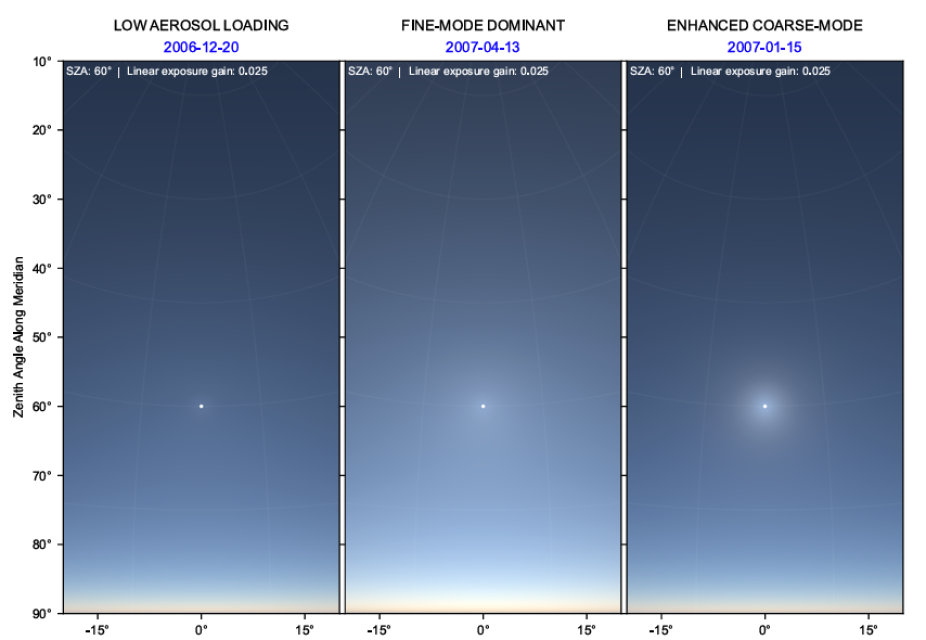
Synthetic true-color circumsolar sky images generated using wavelength-resolved radiative-transfer modeling (libRadtran/DISORT) constrained by AERONET aerosol retrievals for three representative Mauna Loa aerosol regimes: Rayleigh-like, fine-mode–dominated, and coarse-mode forward-scattering. Faint grid lines corresponding to contours of constant altitude and azimuth angles on sky have been added. The images illustrate how differences in aerosol microphysics manifest in the angular structure and apparent brightness of the circumsolar aureole. An animated version of this figure, showing the evolution of the synthetic sky with changing solar elevation, is available in the online journal.