Geophysical Research Letters: Solar flares are enormous explosions on the Sun that are characterized by enhanced radiation in the X-ray and ultraviolet spectra. Such rapid and strong intensifications in the solar emission cause an abrupt increase in the Earth’s ionization, known as a sudden ionospheric disturbance (SID). The SIDs occur instantly and simultaneously on the whole dayside. In this work, we use high-rate 1Hz data of ionospheric total electron content (TEC) and we analyze ionospheric effects of 13 solar flares that occurred between 2003 and 2023. For the first time, we demonstrate that the SID first appears at the subsolar point (i.e., the point where the Sun is directly overhead), and further expands to the twilight regions at a very high speed. We estimated, for the first time, the apparent SID expansion rate to be in the range between 250 and 500 km/s. Our work opens new horizons in the use of high-rate GNSS measurements for studies of the Earth’s ionosphere.
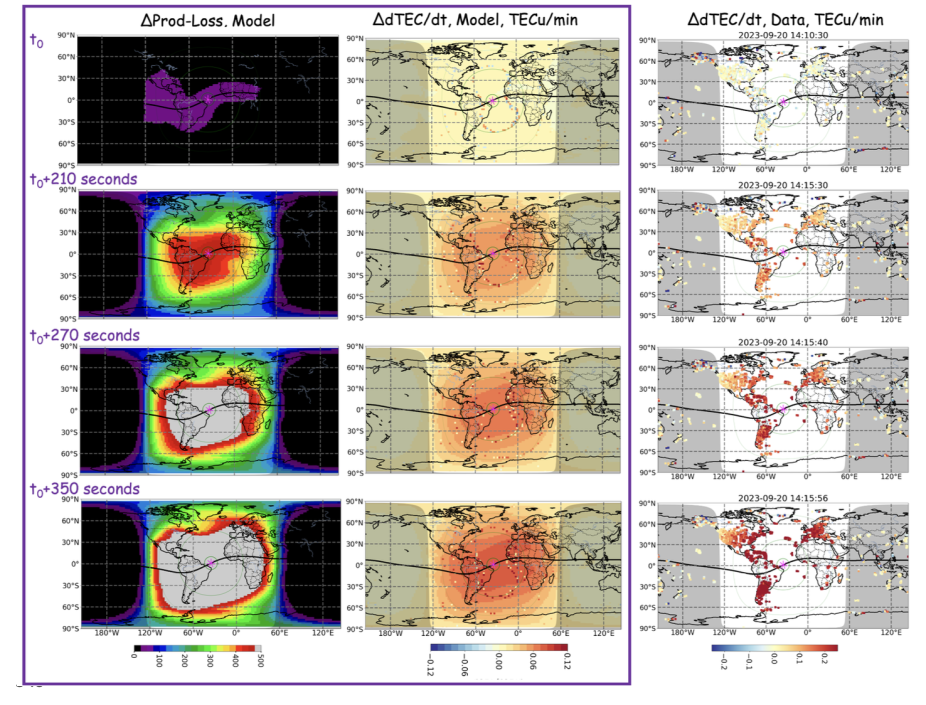
In the purple box, the left and middle panels represent ΔProd-Loss, and dTEC/dt based on the TIEGCM simulations for the 20 Sep 2023 solar flare. The right panels (next to the purple box) depict the dVTEC/dt dynamics by GNSS data during this flare. t0 time corresponds to 14:09:00 UT. The magenta star shows the subsolarpoint (SSP) location, three green lines represent iso‐distance circles from the SSP, from darker to lighter; the black curve is the geomagnetic equator; the shaded grey area shows the night side. The central longitude of the maps is located at the SSP longitude. The results show the expansion of the TEC enhancement from the SSP towards dawn and dusk during the solar flare.