JGR space physics: This study examines the long-term trend of column-integrated atomic oxygen to molecular nitrogen ratio, O/N2, in the upper atmosphere and investigates the cause of this long-term trend in O/N2. We first validate the feasibility of using a physics-based model for a long-term climate reanalysis by applying a model-data comparison between 2002 and 2018. O/N2 simulated by NSF NCAR's Whole Atmosphere Community Climate Model with thermosphere and ionosphere extension (WACCM-X) and measured by Global Ultraviolet Imager (GUVI) aboard the Thermosphere Ionosphere Mesosphere Energetics and Dynamics (TIMED) mission is used to determine the long-term trend of O/N2 from 2002 to 2018 and validate the model result. The model and data show good agreement after removing the impact of solar irradiance and geomagnetic activity using a least-squares fitting method, revealing a decreasing trend of O/N2 of about -0.54% per decade relative to the O/N2 in 2018 in the model and about -0.45% per decade in data along the satellite orbit during the period between 2002 and 2018. A decreasing trend of global O/N2 of about -0.70% per decade is found in the model between 1960 and 2018. After that, four WACCM-X long-term simulations are performed from 1960 to 2018 to identify the cause of the decreasing trend of O/N2. The results show that this decreasing trend is mainly caused by the increase in greenhouse gas concentrations.
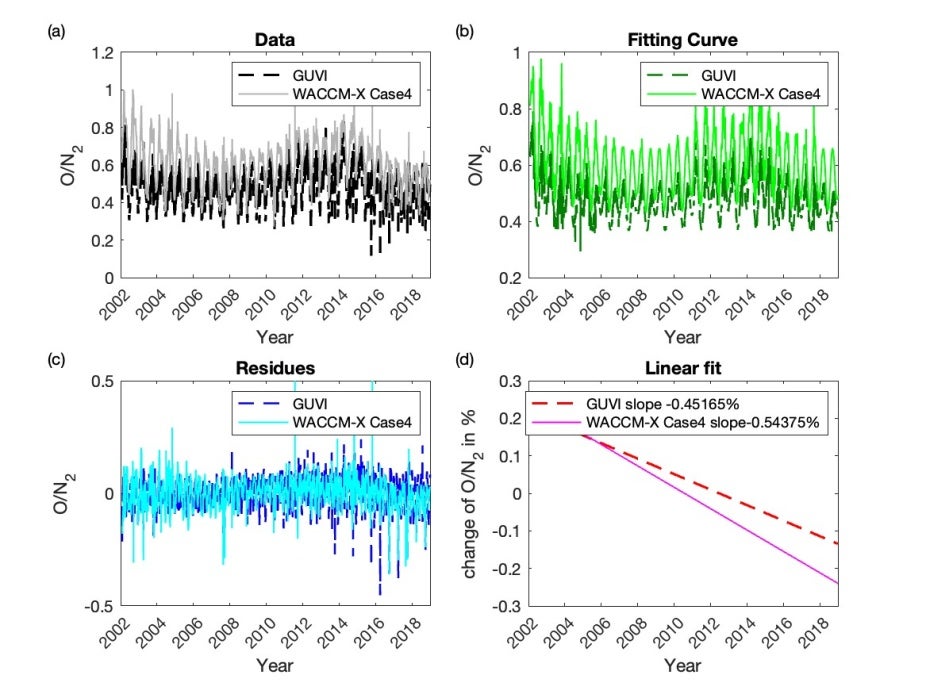
O/N2 measured by TIMED/GUVI and simulated by WACCM-X Case4 and their linear trends. (a) Black and grey lines are the O/N2 data derived from TIMED/GUVI and simulated by WACCM-X, respectively. (b) Dark and light green lines are the fitting curves of the black and grey lines in (a) using the least-squares fitting method with an equation that includes the annual, semi-annual, F10.7 index, and Ap index variations. (c) The blue line is the residual term of TIMED/GUVI O/N2 by subtracting the dark green line from the black line, while the cyan line is the residual term of WACCM-X O/N2 by subtracting the light green line from the grey line. (d) Red and magenta lines are the fitting results of blue and cyan lines using the least-squares fitting method with a linear equation, respectively.