Main navigation

NCAR Logo
High Altitude Observatory
Contact Us
  • Home
  • About
    • HAO News
    • History of HAO
    • People
    • Visitor Program
    • Partnerships
    • Organizational Chart
    • Strategic and Implementation Plans
    • External Advisory Committees
    • Internal Advisory Committees
    • Information for Staff/Visitors
    • Computer Support
  • Research
    • Research Highlights
    • Science Topics
  • Modeling
    • Assimilative Mapping of Ionospheric Electrodynamics (AMIE)
    • Coupled Magnetosphere Ionosphere Thermosphere Model (CMIT)
    • Data-Optimized Coronal Field Model (DOCFM)
    • FORWARD
    • The GLobal airglOW Model (GLOW)
    • Global Scale Wave Model (GSWM)
    • Lyon-Fedder-Mobarry (LFM) code
    • MURaM Sunspot Model Output
    • TIEGCM
    • WACCM-X
    • Living With A Star Focus Team
  • Observation
    • Mauna Loa Solar Observatory
    • COSMO
    • Community Spectro-polarimetric Analysis Center
    • Fabry-Perot Interferometers
    • HAO Eclipses
    • McIntosh Synoptic Map Archive
    • NCAR Vacuum Tunnel Facility
    • Solar Maximum Mission
    • The Sun Today
    • WindCube
    • LFDI
  • Education
    • The Sun: A Pictorial Introduction
    • Questions and Answers About the Sun
    • Solar Physics Historical Timeline
    • Famous Solar-Stellar Scientists
    • Solar Astronomy in the Prehistoric Southwest
    • Suggested Reading
    • Additional Educational Resources
  • News & Events
    • News
    • All Upcoming Events
    • Past Events
Contact Us

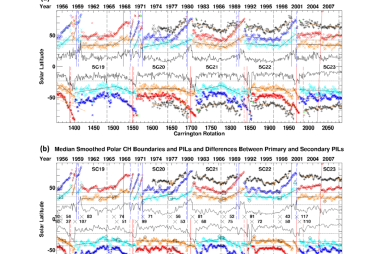
Latitude Variations in Primary and Secondary Polar Crown Polarity Inversion Lines and Polar Coronal Hole Boundaries over Five Solar Cycles

High latitude polarity inversion lines (PILs)

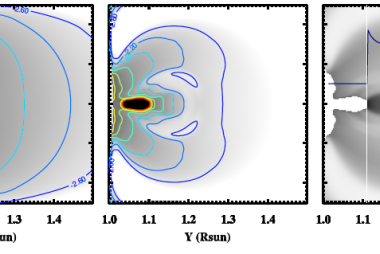
Magnetic field and plasma diagnostics for solar coronal mass ejections: A case study using the forward modeling approach

Liu Fe xiii 10747 line and CME eruption

Coronal spectral diagnostics: The Coronal Solar Magnetic Observatory (COSMO)

UCOMP daily temperature map

Synthetic Lyman-α Emissions for the coronagraph aboard the ASO-S mission I: an Eruptive Prominence-cavity System
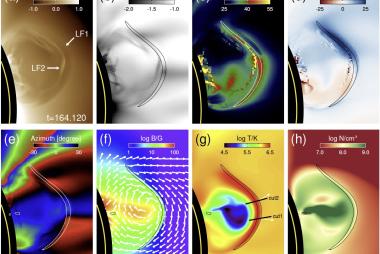
Lyman-alpha emission

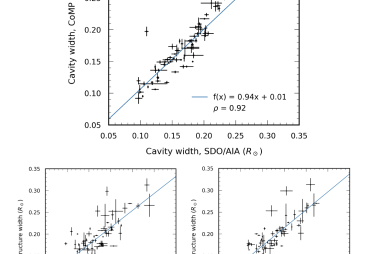
Coronal Cavities in CoMP Observations

Cavity widths observed by SDO/AIA

Tracking Movement Of Long-lived Equatorial Coronal Holes From Analysis Of Long-term McA Data

all Coronal Holes centroids

Sarah Gibson is a 2022 AGU Fellow

Sarah Gibson smiling

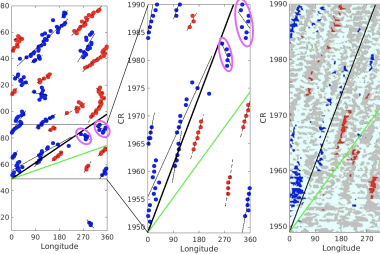
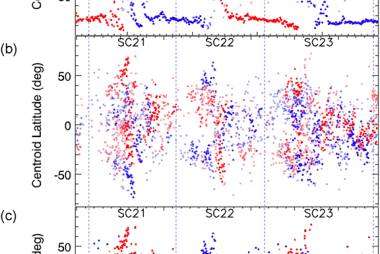
Study of Coronal Hole Lifetimes

Coronal hole centroid latitude vs. Carrington Rotation

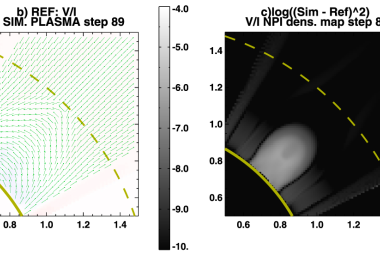
Designing a New Coronal Magnetic Field Energy Diagnostic

Non-potentiality diagnostics of the energized flux-rope simulation at time step 89

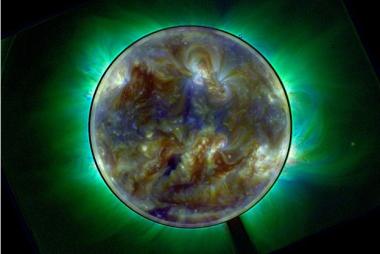
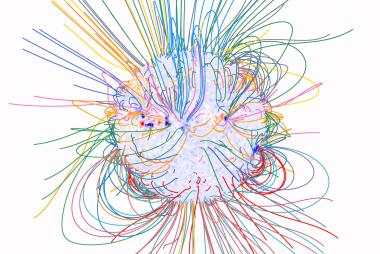
Global Maps of the Magnetic Field in the Solar Corona

Magnetic field of the Sun

Pagination

  • Previous page ‹‹
  • Page 3
  • Next page ››
Subscribe to Sarah Gibson

NSF NCAR

  • NSF NCAR Homepage
  • ACOM | Atmospheric Chemistry Observations & Modeling
  • CGD Laboratory
  • CISL | Computational & Information Systems
  • EdEC | Education, Engagement & Early-Career Development
  • EOL | Earth Observing Laboratory
  • HAO | High Altitude Observatory
  • MMM | Mesoscale & Microscale Meteorology
  • RAL | Research Applications Laboratory

UCAR

  • UCAR Homepage
  • Community Programs
  • Education & Training
  • For Staff
  • Government Relations & External Engagement
  • Member Institutions
  • Tech Transfer & Engagement
  • University Collaboration

Subscribe to NCAR|UCAR News

Follow NCAR|UCAR

© 2026 UCAR

  • Privacy
  • Cookies
  • Web Accessibility
  • Terms of Use
  • Copyright Issues
  • Sponsored by U.S. NSF
  • Report Ethics Concern
  • Staff Login
Postal Address: P.O. Box 3000, Boulder, CO 80307-3000 • Shipping Address: 3090 Center Green Drive, Boulder, CO 80301
NSF Logo

This material is based upon work supported by the NSF National Center for Atmospheric Research, a major facility sponsored by the U.S. National Science Foundation and managed by the University Corporation for Atmospheric Research. Any opinions, findings and conclusions or recommendations expressed in this material do not necessarily reflect the views of the U.S. National Science Foundation.